
Learning to Love
Supermalt: a metaphor for Forgiveness

Supermalt is not like marmite. Being honest, most of us learnt to love it. Even though Supermalt has Dutch origins, it has had a treasured place in the homes, and the hall parties, of African and Caribbean families for decades. It’s part of the culture. But did anyone actually like it when they first had it?
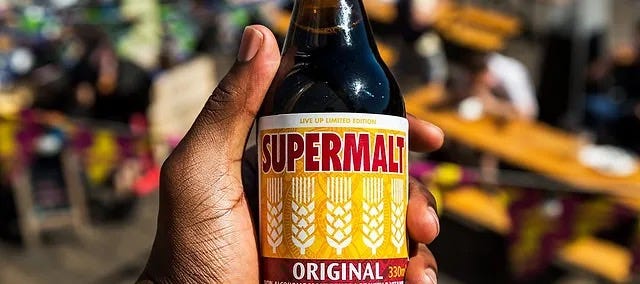
I remember taking a sip of my Dad’s bottle of Supermalt as a child. I was confused as to why a drink that looked so much like Coke tasted so much like bread. I took another tiny sip, trying to decipher the thick, sweet, fizzy liquid coating my tongue. “Ew. I don’t like this,” I thought. Supermalt and I were done.
Fast forward a few years to me happily cracking open a cold bottle of Supermalt at family barbeques, hall parties or whenever the occasion calls. Why? Because I kept trying Supermalt until I became accustomed to the taste.
I’ve heard people describe unforgiveness as “drinking poison expecting the other person to die”. Conceptually I understand that, but it’s always felt too detached from other reasons why someone might be holding on to hurt.
Unforgiveness can be a way to hold the significance of pain; a way to remember that something hurt you and that your being hurt wasn’t inconsequential. Unforgiveness can feel like a way to honour our pain.
Enter boundaries.
Knowing who, how and when people have access to you, and knowing what parts of your world they have access to, has been invaluable in my adult life. Knowing when to say yes and when to say no. Learning that saying yes to something means saying no to something else.
Forgiveness can be hard to exercise when you have to have regular contact with someone who’s hurt you. In some cases, it is wise to cut contact completely with people, especially when your safety and well-being are concerned.
However, there’s a space for a kind of forgiveness that calls us to re-experience someone or something whilst creating new boundaries for experiencing it.
As I grew, I heard people talking about how delicious Supermalt was. I saw people enjoying it having multiple bottles of it alongside plates of jollof rice, freshly grilled chicken and coleslaw. If there was something to love about Supermalt I wanted to know what that was.
So I tried it again, and again, and again. After trying it so many times, I made my Supermalt T's and C’s:
Supermalt is too heavy. I can’t have more than one bottle on any given day.
Fizzy drinks make me feel bloated. So I don’t enjoy drinking supermalt with food.
I don’t like Supermalt in anything other than the glass bottle it came in and it has to be cold.
Enter reform.
I recently watched Unlocked a Netflix documentary following a six-week experiment in a US State Prison where incarcerated persons were allowed to spend six weeks governing themselves with minor intervention from the prison staff.
The response from the inmates was varied, some were sceptical, completely unconvinced that anyone would follow the rules unsupervised. Some were hopeful, believing things could just run as normal and they would be able to keep the doors open.
The experiment aimed to see if the incarcerated persons would change, if they were responsible to and for each other would, acting in the interest of the whole group rather than just themselves.
I won’t ruin it for you. It was interesting to watch how scepticism turned to optimism as people’s life experiences interacted with the opportunity they had to pick a different path. It seemed that many of them behaved one way because they believed there was no hopeful future for them. Once they were given opportunities to change, instead of being condemned for their past mistakes, many of them did.
Enter re-experience.
There’s no real way to know if you, or someone else, has changed unless you experience it again. Going from hating my first sip of Supermalt to enjoying it on hot summer days meant me choosing to re-experience it. I’m not talking about pretending to love something you don’t, but rather being open to re-experience something you might have previously not liked.
Whether it’s people, food or experiences, being open to getting to know something again could give room for it to have a place in our lives that it didn’t once have.
Food for thought: Forgiveness is the willingness to continue experiencing something.
Forgiveness has always felt weighty. I’ve always seen it as a decision you make - a stake in the ground. But I’ve found ease in seeing forgiveness as an exercise in open-mindedness. A decision to continue experiencing someone or something. Forgiveness can start as a decision to continue to make observations about who or what something is, instead of crowning them as the sum total of their worst moment.
Forgiveness is freedom! It is freeing space for oneself. Thank you for this piece!